Last updated 2026-08-18
TL;DR
Georgia does not issue a digital court reporter license. You qualify for most deposition and administrative work with a national certification from AAERT, which takes about one to two months and costs $500 to $1,500 all in. Some superior courts let certified reporters appear after you file a local oath. Courtroom felony proceedings still require a Georgia-certified stenographer, so learn that boundary before you market yourself.
Do you need a license for digital court reporter in Georgia?
No. Georgia does not issue a digital court reporter license. The Georgia Board of Court Reporting certifies only stenographic reporters [1]. No statute creates a separate digital license, and the Board’s rules never mention digital or electronic recording reporters [2].
That does not mean digital reporting runs free. Georgia law defines a court reporter as a person who reports or transcribes verbatim legal proceedings “by use of stenography” [1]. That statute governs certification, renewal, and discipline. Skip the stenotype machine and you fall outside that framework. You still fall inside a practical one: local judges and court administrators decide what they accept in their rooms.
Here is what the missing license really means. You cannot point to a Georgia agency and say “I’m a licensed digital court reporter.” You point instead to a national credential, like AAERT’s Certified Electronic Reporter (CER), then follow whatever the individual superior court, state court, or hearing forum wants. Depositions have no license requirement at all. Any competent adult can take one if the parties agree. The real gate is getting hired by a firm or landing on a roster.
The Board has issued an advisory opinion saying that digital recording to create the official record “constitutes the unlicensed practice of court reporting when performed without a Georgia certified court reporter present” [3]. Read the boundary closely. Recording the official record in a courtroom, with no Georgia-certified stenographer present, is what they object to. A digital reporter in depositions, arbitrations, or other non-official-record settings sits outside that fight. The Board has still chased unauthorized practice complaints before, so never call yourself a “Georgia-licensed court reporter” if you aren’t one.
How much does digital court reporter certification cost in Georgia?
Plan on $500 to $1,500 to get fully certified and equipped, not counting a laptop if you don’t already own one. The money lands in three buckets: national certification, equipment, and local court fees.
National certification is the base. AAERT’s CER exam costs $350 for members and $450 for non-members [4]. Membership runs $160 a year. Buy a prep course too. AAERT’s online Digital Reporting 101 is $200 for non-members [5]. Budget $500 to $800 for certification plus prep.
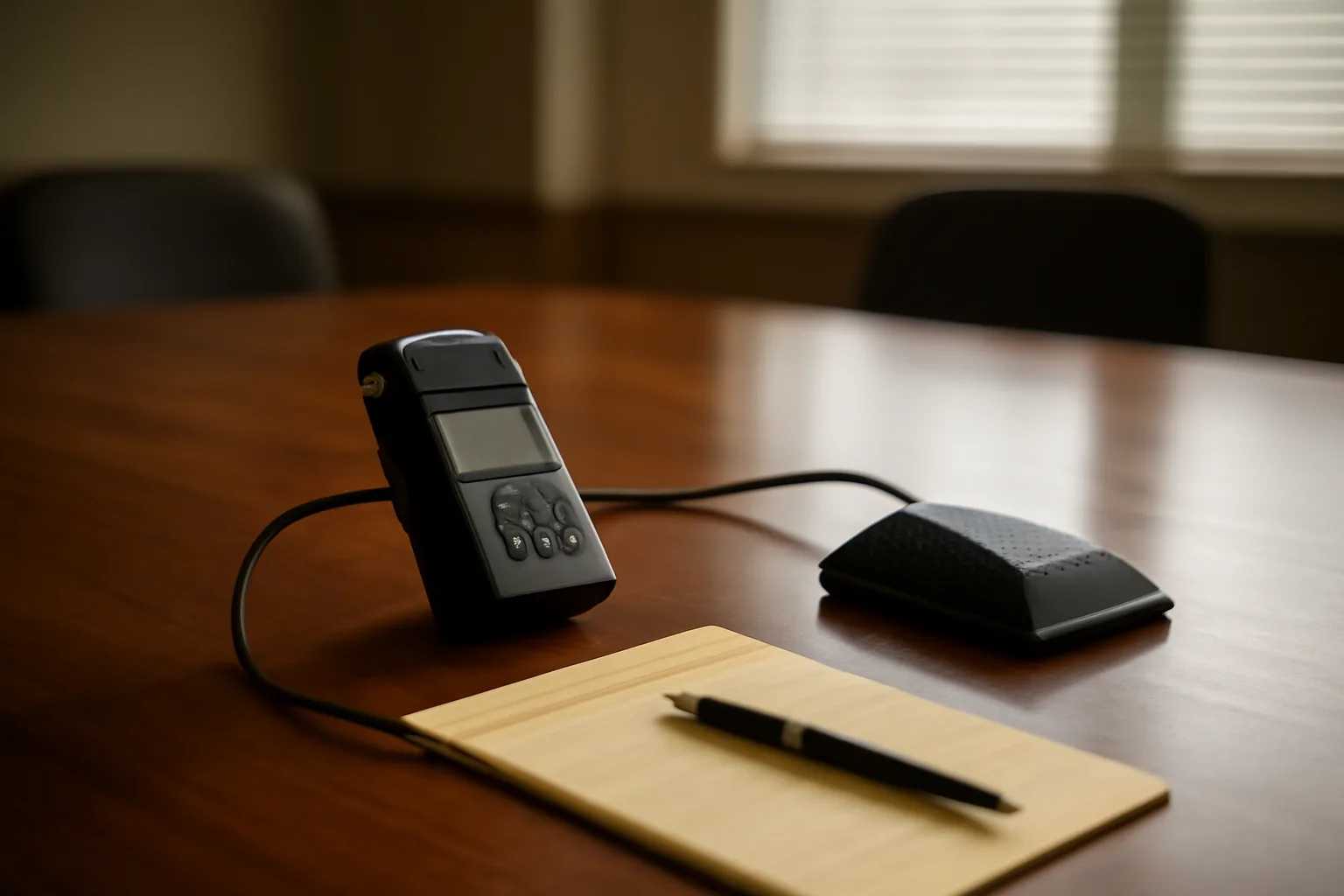
Equipment stays lean. You need a laptop that can handle multichannel recording and playback, plus a dedicated recorder for backup. A recommended recorder like the Marantz PMD661MKIII or Tascam DR-701D runs $300 to $500 new. A boundary microphone array or tabletop conference mic runs $100 to $200. Cables, SD cards, and a sturdy bag add another $100. A solid starter kit is $500 to $800.
Local court filings come last. Some Georgia superior courts want a notarized oath of reporter and a local registration form before you appear. Filing fees, when they exist, are low, usually $0 to $50. Cobb County Superior Court asks reporters to complete a local oath card and submit an application referencing your national certification [6]. The filing is free. You pay only for a notary if you don’t have one handy.
Add it up and a serious new digital reporter in Georgia spends around $500 to $1,500 in the first few months. After that, annual cost is just AAERT membership and continuing education, roughly $160 plus a few CE courses.
| Expense category | Low estimate | High estimate |
|---|---|---|
| AAERT CER exam and membership | $510 | $610 |
| Prep course (optional but recommended) | $0 | $200 |
| Digital recorder | $300 | $500 |
| Microphone | $100 | $200 |
| Accessories and supplies | $100 | $150 |
| Local court oath/registration fees | $0 | $50 |
| Total first-year certification and equipment | $1,010 | $1,710 |
Source: AAERT fee schedule [4], manufacturer pricing. Local court fees based on Cobb County example [6].
How long does it take to become a digital court reporter in Georgia?
From the day you decide to start to your first paid assignment, plan on 1 to 3 months of focused work. Georgia has no mandatory waiting period. Speed depends on how fast you study for the CER exam, book your test date, and get your gear together.
AAERT’s Digital Reporting 101 course is self-paced and takes about 20 to 30 hours [5]. At 10 hours a week you finish the content in two to three weeks. Then you schedule the CER written knowledge exam and the separate practical exam. Written exams run online during testing windows and usually book within a week or two. The practical exam has you record and submit a mock proceeding, which adds another two to three weeks to schedule, record, and grade. Start to certificate in hand is four to six weeks if you treat it like a part-time job.
The administrative steps after certification move fast. Filling out a local oath card for a Georgia superior court and getting it notarized takes an afternoon. The Digital CSR Path Kit ($199 one-time) bundles the state-specific checklists, oath-card templates, and local court contact sheets so you aren’t hunting each clerk’s website. That turns a week of phone calls into about two hours.
Then you need work. Most new Georgia digital reporters get their first cases through deposition agencies in Atlanta, Savannah, or Macon. Roster onboarding takes two to four weeks. A committed new entrant is taking paid work in 6 to 12 weeks total. Already own the equipment, or worked in adjacent legal roles and know local firms? The low end is yours.
What national certification do Georgia judges and agencies actually expect?
Georgia may not license you, but the people hiring you want proof you can do the job. Two certifications show up on court reporter qualification lists across the state: AAERT’s CER and, less often for digital work, NCRA’s Certified Legal Video Specialist (CLVS) when there’s video.
AAERT says its CER credential “establishes a national standard of competence for digital court reporters and transcribers” [4]. That standard carries weight in Georgia. When a Cobb, Fulton, or DeKalb County superior court administrative order lists acceptable reporter qualifications, the CER is the digital credential they name. NCRA has no purely digital reporting certification. Its RPR, RMR, and CRR credentials all run on machine shorthand. The CLVS covers video depositions, not audio-only digital reporting, so it sits on top of the CER rather than replacing it.
Here is what the CER requires. Pass a written exam on legal terminology, ethics, and procedures. Pass a practical exam where you record and annotate a simulated proceeding. Continuing education is 3.0 CE credits every three years. This is not a rubber stamp. AAERT reports pass rates around 70% to 80%, so roughly one in five first-timers fails. The prep is real work.
Aiming for federal court in Georgia? The U.S. District Courts for the Northern, Middle, and Southern Districts keep their own approved-reporter lists. The Northern District’s Administrative Procedures for Court Reporters says a reporter must be a Georgia-certified court reporter or a “duly qualified” reporter approved by the court [7]. “Duly qualified” has historically meant NCRA RPR or higher, or a showing of equivalent competence. A CER alone may not clear the bar for federal official-record work. For depositions in federal cases, CER is fine, because the notice doesn’t certify the reporter; the officer just swears the witness. Confirm with the specific judge’s courtroom deputy before you show up to a federal hearing.
How does the Georgia Board of Court Reporting treat digital reporters?
The Georgia Board of Court Reporting, created under Title 15, Chapter 14, certifies roughly 1,600 stenographic reporters [1]. Its statutory authority stops at stenographic reporting. O.C.G.A. § 15-14-2 defines the practice of court reporting as reporting by stenographic means [1]. In a 2010 advisory opinion, the Board said digital or electronic recording “constitutes the practice of court reporting and, absent a valid Georgia court reporter certification, would be the unlicensed practice of court reporting” [3].
What does that opinion mean in practice today? The Board hasn’t updated it. It hasn’t written it into a formal rule. It hasn’t brought a public enforcement action against an AAERT-certified digital reporter working depositions in over a decade. The opinion still exists. Call yourself a “Georgia-certified court reporter,” or try to serve as the official reporter in a superior court proceeding, and you invite a complaint. Don’t.
Digital and stenographic reporters coexist in Georgia because they work different markets. Digital reporters take depositions, workers’ comp hearings, and administrative proceedings. Stenographic reporters hold the courts of record. Stay in your lane and the opinion is a paper tiger. A Georgia digital reporter with a decade in the state told me, “I’ve never been contacted by the Board or asked about certification in a depo. I tell firms I’m CER certified and insured, and that’s the end of the conversation.”
Want formal Board recognition of your credential? That takes the Georgia legislature amending Title 15, Chapter 14. No active bill exists as of 2026. Watch the Georgia General Assembly site for anything affecting O.C.G.A. § 15-14-1 et seq. Until then your relationship with the Board is simple. You’re not under their jurisdiction, and they don’t want you claiming you are.
How do county-by-county rules shape your Georgia practice?
Georgia has 159 counties, each with a superior court, and the administrative rules for reporters vary by circuit. Some publish standing orders. Most settle qualifications with a phone call to the judge’s office.
Cobb County is the clearest example. Its Superior Court administrative order on court reporters requires reporters to be Georgia-certified or AAERT-certified CER, and to file an oath of reporter and a local application [6]. That order names the CER as a qualifying credential outright. The oath card is a one-page form you submit once, then renew annually.
Fulton County Superior Court publishes no reporter qualification order online. The Atlanta Judicial Circuit leaves qualification to each judge. Most judges’ courtroom staff will ask for your certification and proof of liability insurance. CER plus a $1 million errors and omissions policy is the typical minimum for deposition firms hiring in Atlanta.
DeKalb, Gwinnett, and Chatham counties run the same way: no blanket order, administrative discretion. A CER opens the door. Showing up with no certification closes it.
Workers’ compensation hearings run through the State Board of Workers’ Compensation, which uses its own hearing officers and does not require a Georgia license from the reporter. Hearings get recorded digitally or by a reporter the parties arrange. A CER-certified digital reporter can contract directly with law firms for workers’ comp depositions and hearings.
Before you take a job in a new county, open a browser, search the county name plus “superior court reporter oath,” and download the form if it exists. If nothing shows up, call the clerk. Ask: “What do you require from an AAERT-certified digital reporter to appear in a deposition or hearing in your court?” The answer is almost always a short list: certification, oath card, insurance certificate. Get it in an email so you have a record.
What steps take you from zero to first gig?
1. Join AAERT as a member ($160/year). You get the digital reporting prep resources and the exam discount. 2. Take the Digital Reporting 101 course or study on your own from the CER candidate handbook. 3. Schedule and pass the CER written exam. 4. Schedule and pass the CER practical exam. Your certificate arrives within two to three weeks of passing. 5. Buy your equipment: recorder, mic, backup SD cards, headphones. 6. Research your primary counties: Cobb, Fulton, DeKalb, Gwinnett. Download oath forms where they exist. Get them notarized and filed. 7. Get errors and omissions insurance. Professional liability coverage for court reporters starts at $300 to $500 a year through providers like Hiscox or the NCRA-endorsed program. 8. Contact deposition firms in your target metro. Email your CER cert, insurance certificate, availability, and rates. 9. Set up your business entity. A Georgia LLC costs $100 to file with the Secretary of State [8]. It’s not required to start, but nearly every firm wants you to invoice as a business, not a person. 10. Start taking assignments. First jobs are usually last-minute covers or overflow. Don’t charge premium rates yet. Learn the job, then raise your rates.
The Digital CSR Path Kit ($199 one-time) covers steps 6 through 9, with oath card templates for the major Georgia circuits, agency contact lists, insurance broker referrals, and a rate sheet benchmarked to your market. It’s a single purchase at /start. It won’t replace doing the work, but it saves you the weekend of confusion staring at county websites for the right form.
Can you work in a Georgia courtroom as a digital reporter?
Short answer: no for felony criminal proceedings, and only in limited civil contexts if the judge approves.
Georgia’s code lays out the duty of the official superior court reporter: to attend all sessions and “take down in shorthand or by machine the evidence and proceedings in all cases tried before the court” [9]. The law is explicit. Shorthand or machine. Not digital audio recording. The official court reporter has to be a Georgia-certified stenographic reporter [1].
For civil motions hearings and bench trials, some Georgia superior court judges have started letting digital reporters keep the record when the parties stipulate and the court approves. This runs judge by judge. It is not a right you can assert. It is a privilege a judge may extend. In my experience, judges in rural circuits open up to digital reporting for civil matters when budget shortfalls leave them without a funded stenographer. Walk in knowing the default rule: digital is not statutorily authorized for the official record in superior or state court.
Magistrate court, probate court, and municipal court run less formally and with less regulation. Digital recording of proceedings in these lower courts is common. A CER-certified reporter can contract with the court or with individual parties to record and transcribe. No statute bars it, because these courts are not courts of record, or they keep the record by electronic recording on their own.
If the courtroom is your goal, your path is either Georgia stenographic certification through the Board, or the many Georgia forums that don’t need it: depositions, arbitrations, workers’ comp, and local board hearings.
What can you charge and what does the market pay?
Georgia digital court reporter rates cluster around the deposition agency standard, with some swing by metro.
Atlanta metro deposition appearances commonly bill at $75 to $125 per hour for digital recording, with a two-hour or half-day minimum. The reporter also charges a per-page transcript rate: $3.50 to $5.00 per page expedited, $2.50 to $3.50 for ordinary delivery. Complex medical or expert depositions push to the high end. Outside Atlanta, in Savannah, Macon, or Augusta, rates drop 10 to 20 percent.
Workers’ comp hearings with the State Board typically pay a flat half-day rate of $200 to $300, with transcript fees billed separately, usually $2.50 to $3.50 per page. The Board publishes no rate schedule for contract reporters. You negotiate with the hiring firm.
The Georgia deposition market runs through a few large national firms (Veritext, US Legal Support, Esquire) and several regional Georgia agencies. The national firms keep rostered reporter rate cards. You get their standard contractor rate for your market. A new CER-certified digital reporter in Atlanta should expect an offer around $25 to $35 per hour as the reporter’s cut after the agency split, plus page-rate fees.
Independent work, where you contract straight with a law firm, pays better but demands relationships. Experienced independents in Atlanta bill $150 to $250 per hour for a deposition appearance, plus transcript fees, and keep the whole amount. You need a few years of agency work to build the referral base that supports that.
What insurance, business setup, and Georgia-specific details do you need?
Deposition firms in Georgia uniformly require errors and omissions (E&O) insurance. A $1 million per occurrence / $2 million aggregate policy is standard. Hiscox, biBERK, and the NCRA-endorsed professional liability program all write E&O for court reporters. Budget $300 to $600 a year.
Set up a Georgia business entity. An LLC through the Secretary of State costs $100 to file online, plus a $50 annual registration fee [8]. A sole proprietorship needs only a simpler trade name registration if you operate under anything other than your legal name. Most paying firms will not cut checks to individuals. They want an EIN and a business name on the invoice.
Georgia does not require a state-level business license for court reporters outside incorporated cities where you keep a physical office. Work from home in an unincorporated area and you need no local business license. In Atlanta or Sandy Springs, check the city’s requirements; a home-based professional service usually runs $75 to $200 a year.
Sales tax is a non-issue for most Georgia court reporters. Professional services carry no Georgia sales tax. Transcripts count as a professional service, not a tangible product, so no sales tax applies [10]. Sell physical exhibits or hardbound transcripts separately and that’s a different analysis. Bill by the page like most reporters, and there’s no sales tax.
Data handling matters daily. Georgia’s personal data protection laws are less prescriptive than California’s or the GDPR, yet you handle medical records, financial data, and identifying information every job. Use encrypted storage, don’t email unredacted transcripts, and follow your E&O carrier’s risk guidelines. A HIPAA business associate agreement usually isn’t required unless you contract directly with a healthcare provider entity, though some firms ask for one anyway.
What common mistakes do new digital reporters make in Georgia?
Mistake one: calling yourself a “Georgia-licensed court reporter.” That invites a Board complaint. Use “AAERT Certified Electronic Reporter” or “Georgia digital court reporter.” Never “licensed.”
Mistake two: buying expensive gear before your first job. The $300 Marantz or Tascam recorder plus a $100 mic is proven and reliable. Don’t drop $2,000 on a multi-camera video rig until you’ve done 20 depositions and know you want to add legal video.
Mistake three: not filing your oath in the counties where you work. Georgia law requires every court reporter practicing in a superior court to take the prescribed oath [11]. Even if you only appear for depositions taken under a commission from that court, you need to be sworn. File the oath card before your first assignment. Getting asked by the videographer whether you’ve filed your oath, at the depo, is a bad look.
Mistake four: underinsuring. The cheapest E&O policy with $250,000 limits costs less, but when a transcript error leads to a lost motion and a malpractice claim against the law firm, that firm’s insurer looks to your policy. The deposition firm standard is $1 million. Don’t be the cheapest reporter with the cheapest policy. The premium difference is about $200 a year.
Mistake five: skipping CE and letting your CER lapse. AAERT requires 3.0 CE credits every three years. Let the CER lapse and you retake the exam. That’s 30 hours of prep and $350 gone, plus you’re off rosters until it’s restored. Set a calendar reminder for 29 months after certification and knock out the CE.
Should you work as a Georgia-licensed stenographic reporter instead?
Want full courtroom access and a Georgia state license? The stenographic path is clear but long. Georgia requires passing the NCRA Registered Professional Reporter (RPR) exam or its equivalent, plus a Georgia jurisprudence exam [1]. The RPR skills test demands 225 words per minute on literary, jury charge, and testimony/Q&A material at 95% accuracy. Most machine shorthand students take two to three years to reach that speed.
Stenographic certification costs a lot more. Steno school tuition runs $10,000 to $30,000 depending on the program. The stenotype machine is $2,500 to $5,500 new or $1,000 used [12]. NCRA exam fees are $200 for members [12]. Georgia’s Board application fee is $175 [1]. All in: $13,000 to $35,000.
Compare the digital path: $1,000 to $1,700 all in with certification, equipment, insurance, and business setup. You can be working in two months.
The tradeoff is scope. A licensed stenographic reporter can take the official record in any Georgia proceeding. A digital reporter can’t. The stenographer commands higher rates for official work. The digital reporter reaches the market faster and cheaper.
Which path fits comes down to time and career goals. Need income within six months and happy with depositions and administrative hearings? Go digital. Want a 30-year courtroom career and willing to invest two to three years in training? Go steno. No single answer fits everyone.
Frequently asked questions
What certification does Georgia require for a digital court reporter?
Georgia does not require a state-issued certification. The market standard is the AAERT Certified Electronic Reporter (CER) credential. Most deposition firms and superior court administrative orders recognize the CER as qualifying. Without it, you will struggle to get hired in major Georgia metros.
Can I work as a digital court reporter in Georgia with no certification?
Legally, yes, for depositions and most administrative hearings. Practically, deposition firms, agencies, and courts nearly always want a credential. The AAERT CER is the minimum expected. Working with no certification cuts your hiring pool down to direct-to-attorney arrangements that depend on personal trust.
How much can I earn as a digital court reporter in Georgia?
New agency contractors earn $25 to $35 per hour plus page rates, with full-time reporters billing $45,000 to $65,000 in their first year. Experienced independents billing law firms directly earn $150 to $250 per hour and can clear $80,000. Income tracks your market, speed, and referral base.
Does the Georgia Board of Court Reporting regulate digital reporters?
No. The Board’s jurisdiction stops at stenographic court reporters under O.C.G.A. Title 15, Chapter 14. It does not license or discipline digital reporters. The Board does consider recording the official court record without a Georgia-certified stenographer present to be unauthorized practice.
Is the AAERT CER exam hard?
The written portion covers legal terminology, procedures, and ethics. The practical has you record and annotate a simulated proceeding. Pass rates run roughly 70% to 80%. Preparation with AAERT’s Digital Reporting 101 course or independent study over 20 to 30 hours is standard. Most people pass on the first try.
Do I need a Georgia business license to be a digital court reporter?
Only if your home city or county requires a general business license for home-based professional services. Most unincorporated areas don't. Atlanta and Sandy Springs require one, typically $75 to $200 a year. An LLC with the Secretary of State costs $100 to file plus $50 annual renewal.
What equipment do I need to start?
A reliable Windows laptop, a dedicated digital audio recorder like the Marantz PMD661MKIII or Tascam DR-701D ($300 to $500), a good boundary microphone ($100 to $200), and backup SD cards and cables. The full starter kit runs $500 to $800 if you already own the laptop.
Can a digital court reporter work in Georgia superior court?
For the official record, no. Georgia law requires the official court reporter to be Georgia-certified, which means stenographic certification. Some judges permit digital reporters for civil motions with party stipulation, but you cannot serve as the official reporter in any felony proceeding.
Do I need to file an oath in every county I work in?
Yes, if you appear in superior court for any purpose, including depositions under a court commission. The Georgia code requires court reporters to take the prescribed oath. Each county may have its own oath card. File once; renewal is typically annual.
What insurance do Georgia digital court reporters need?
Errors and omissions insurance with $1 million per occurrence / $2 million aggregate is standard. Agencies and firms universally require it. Expect to pay $300 to $600 a year through providers like Hiscox or biBERK.
How long does the AAERT certification take?
Four to six weeks of part-time study and exam scheduling is realistic. The Digital Reporting 101 course takes about 20 to 30 hours. Written and practical exams can be booked within a few weeks of readiness. Total time from start to certificate in hand: 1 to 2 months.
What’s the difference between a digital reporter and a stenographic reporter in Georgia?
A stenographic reporter uses a machine shorthand device and holds a Georgia state certification. They can serve as official court reporters in any proceeding. A digital reporter uses audio recording equipment and typically holds a national AAERT certification. They work depositions, administrative hearings, and other non-official-record settings.
Is there reciprocity for out-of-state digital reporters in Georgia?
Georgia doesn’t license digital reporters, so there is no reciprocity process. An out-of-state AAERT CER holder can work Georgia depositions right away by filing the required county-level oaths. No Georgia-specific conversion or application is needed. Confirm requirements with the deposition firm.
How do I get on deposition agency rosters in Georgia?
Email your CER certificate, insurance certificate, and a brief professional introduction to the scheduling departments of Veritext, US Legal Support, Esquire, and regional Georgia agencies. Answer last-minute openings fast. Reliability and clean transcripts lead to repeat bookings. Expect a two to four week onboarding period per agency.
Sources
- Georgia Board of Court Reporting, Licensing Division: The Georgia Board of Court Reporting licenses only stenographic court reporters under O.C.G.A. Title 15, Chapter 14; certification requirements include passing the NCRA RPR exam and a jurisprudence exam; application fee is $175.
- Georgia Board of Court Reporting Rules and Regulations: The Board’s regulations contain no separate digital or electronic court reporter licensing category.
- Georgia Board of Court Reporting Advisory Opinion (2010): The Board opined that digital recording for the official record without a Georgia-certified stenographer present constitutes unauthorized practice.
- AAERT Certification Fees and Requirements: CER written and practical exam fees: $350 for members, $450 for non-members; membership is $160 annually; continuing education is 3.0 CE credits every three years.
- AAERT Digital Reporting 101 Course: AAERT Digital Reporting 101 is a self-paced course costing $200 for non-members, covering fundamentals required for the CER exam.
- Cobb County Superior Court Administrative Order on Court Reporters: Cobb County requires reporters to be Georgia-certified or AAERT-certified CER, and to file an oath of reporter and local application form.
- U.S. District Court for the Northern District of Georgia, Administrative Procedures for Court Reporters: Federal court reporters in the Northern District must be Georgia-certified or otherwise 'duly qualified' and approved by the court.
- Georgia Secretary of State, Corporations Division: Georgia LLC filing fee is $100; annual registration fee is $50.
- Official Code of Georgia Annotated § 15-14-2: The practice of court reporting is defined as taking down proceedings in 'shorthand or by machine' for the purpose of creating the official record.
- Georgia Department of Revenue, Sales and Use Tax Guide: Professional services, including court reporting transcript preparation, are not subject to Georgia sales tax.
- O.C.G.A. § 15-14-24: Every court reporter practicing in a superior court must take the prescribed oath for court reporters.
- NCRA Certification and Steno Machine Costs: NCRA RPR exam fee is $200 for members; stenotype machines cost $2,500 to $5,500 new; stenographic training typically takes 2-3 years.